Annual Reports
TaskUs, Inc.'s annual reports contain management's most considered account of the business. These are the sections, passages and visual pages worth opening in the originals preserved in Sources.
TaskUs, Inc. — FY2025 Annual Report (Form 10-K) — FY2025
Latest 10-K: the fullest account of the three service lines, the Meta/offshore concentration, and how AI is both engine and threat to a BPO. · Open the full document →
Item 1. Business — Overview — p. 8 · Read the full section →
Defines the model in one place: three services, ~200 clients, and the FY2025 revenue mix (Digital CX 56%, Trust & Safety 26%, AI 18%).
What TaskUs does and how revenue splits across its three service lines.
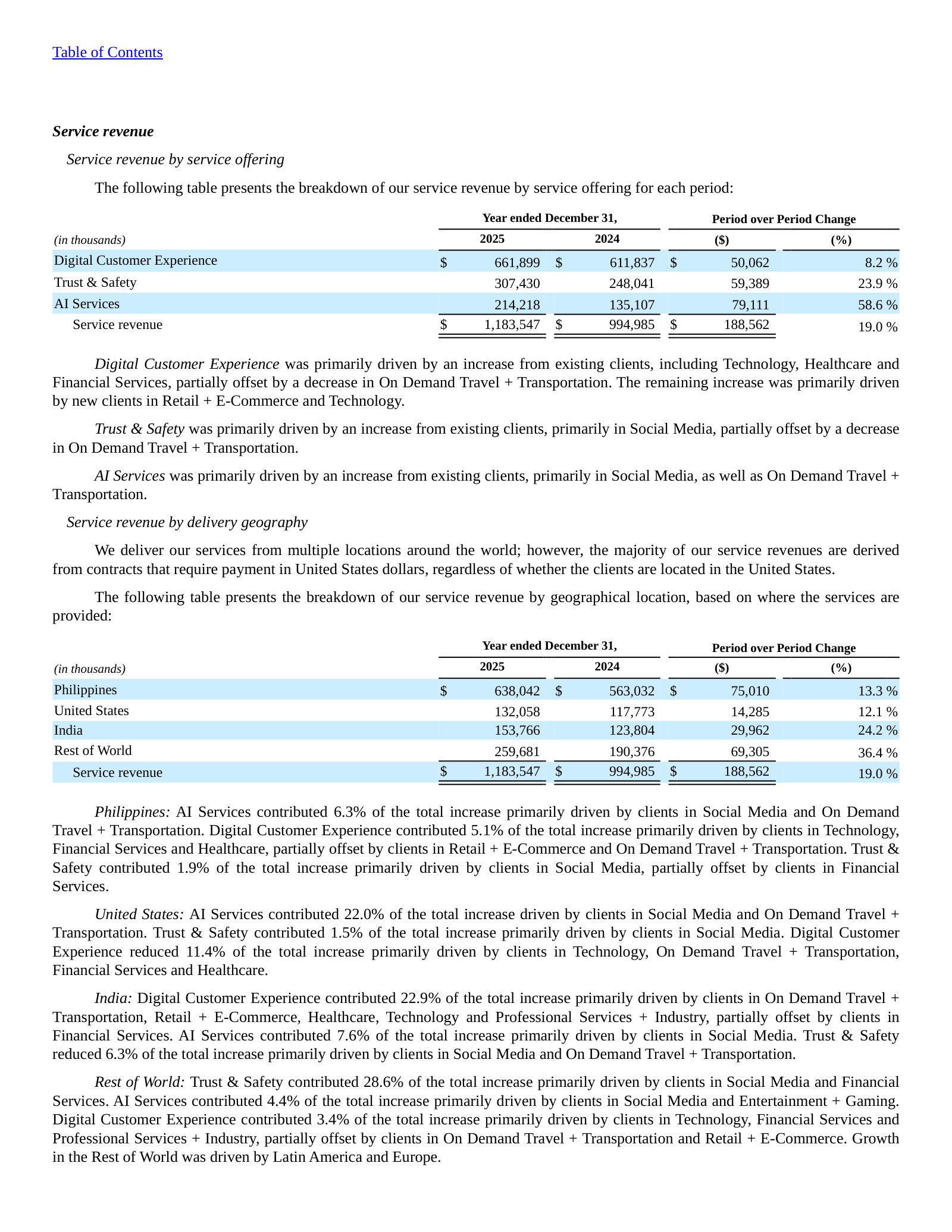
We deliver outsourced digital services that power the companies shaping the future. By combining specialized human talent and intelligent technology, we solve complex operational challenges for global category leaders within AI, autonomous vehicles, robotics, social media, financial services, healthcare, and beyond. […] As of December 31, 2025, we supported approximately 200 clients. […] For the fiscal year ended December 31, 2025, Digital Customer Experience, Trust & Safety and Artificial Intelligence Services represented 56%, 26% and 18%, respectively, of our total service revenue of $1,183.5 million compared to 61%, 25% and 14%, respectively, of our total service revenue of $995.0 million for the year ended December 31, 2024.
p. 8 · Read in context →
Human Capital and Global Delivery — p. 14 · Read the full section →
The cost model laid bare: an offshore, non-voice delivery base with 58% of ~65,500 staff in the Philippines.
Offshore/near-shore delivery: 87% non-voice revenue, Philippines is 58% of headcount, 31 sites in 13 countries.
Utilizing primarily offshore and near-shore markets is a central tenet of our service delivery strategy. Since 87% of our revenue in 2025 was delivered from non-voice, digital channels or omnichannel services, we are particularly well positioned to leverage an offshore/near-shore model. The Philippines is our largest off-shore market with approximately 38,100 people, or 58%, of Headcount of approximately 65,500 people worldwide. […] As of December 31, 2025, we operated across 31 locations in 13 countries in 2025.
p. 14 · Read in context →
Our Clients — p. 17 · Read the full section →
The single biggest fact in the filing: revenue is concentrated in a handful of clients, with Meta alone at 26%.
Client concentration: top 10 = 58% of revenue, top 20 = 71%, and Meta = 26%.
As of December 31, 2025, we supported approximately 200 clients, most of which are innovative companies in attractive, high growth industry verticals, including social media, e-commerce, gaming, streaming media, food delivery and ride sharing, technology, financial services, and healthcare. […] Our top 10 and top 20 clients accounted for 58% and 71% of our revenue for the fiscal year ended December 31, 2025, respectively. Our largest client, Meta, generated 26% of our revenue for the fiscal year ended December 31, 2025.
p. 17 · Read in context →
Item 1A. Risk Factors — Dependence on key clients — p. 22 · Read the full section →
Quantifies the concentration risk: losing any one of the top five (45% of revenue) or the top client (26%) would hurt materially.
Top five clients = 45% of revenue; the loss of a key client could materially harm results.
We derive a substantial portion of our revenue from a few key clients who generally retain us across multiple service offerings. Our top five clients accounted for 45% of our revenue for the fiscal year ended December 31, 2025. Our top client accounted for an aggregate of 26% of our revenue for the fiscal year ended December 31, 2025, across multiple service offerings. The reduction in revenue or loss of all or a portion of our business with, or the failure to retain a significant amount of business with, any of our key clients could have a material adverse effect on our business, financial condition or results of operations.
p. 22 · Read in context →
Item 1A. Risk Factors — AI could reduce demand for our services — p. 26 · Read the full section →
The existential question for a BPO stated plainly: the same Generative/Agentic AI it sells could shrink client spend.
Generative and Agentic AI could decrease demand for certain service offerings and reduce client spend.
Increased adoption and utilization of AI, including Generative AI and Agentic AI, by our clients and us, or our failure to appropriately incorporate Generative AI and Agentic AI into our operations, could adversely affect our business, reputation or financial results. […] As Generative AI and Agentic AI technologies continue to develop, demand for certain service offerings could decrease, further reducing our clients’ spend, which could have a negative impact on our revenue.
p. 26 · Read in context →
Item 1A. Risk Factors — Content moderation and employee well-being — p. 28 · Read the full section →
A liability unique to this business: moderators exposed to prohibited content, with unknown long-term mental-health effects.
Trust & Safety work may cause stress disorders and create liabilities, drawing press and regulatory scrutiny.
Trust & Safety, including content moderation and monitoring services, is a large and growing portion of our business. The longterm impacts on the mental health and well-being of our employees doing this work are unknown. This work may lead to stress disorders and may create liabilities for us. This work is also subject to significant press and regulatory scrutiny.
p. 28 · Read in context →
Item 1A. Risk Factors — Dependence on the Philippines and India — p. 32 · Read the full section →
Geographic concentration risk: 54% of revenue is delivered from the Philippines, exposed to typhoons and political instability.
54% of revenue delivered from the Philippines; disruption there or in India would adversely affect the business.
Our business is heavily dependent upon our international operations, particularly in the Philippines and India, and any disruption to those operations would adversely affect us. […] During the fiscal year ended December 31, 2025, we derived 54% of our revenue from work performed in the Philippines, 11% of our revenue from work performed in the United States and 13% of our revenue from work performed in India. The Philippines has experienced political instability, acts of natural disaster, such as typhoons and flooding, and the occasional health and security threat and continues to be at risk of similar and other events that may disrupt our operations.
p. 32 · Read in context →
Item 7. Management’s Discussion and Analysis — p. 74 · Read the full section →
Management explains the FY2025 result: 19% revenue growth to $1.18B, net income up 123%, and where each service line grew.
FY2025 results: net income +123% to $102.3M, Adjusted EBITDA +18.7% to $249.1M.
For the year ended December 31, 2025, we recorded net income of $102.3 million a 123.0% increase from $45.9 million for the year ended December 31, 2024, due primarily to higher revenue growth and the impact of foreign currency exchange rates, partially offset by higher cost of services. Adjusted Net Income for the year ended December 31, 2025 increased 27.8% to $151.7 million from $118.7 million for the year ended December 31, 2024. Adjusted EBITDA for the year ended December 31, 2025 increased 18.7% to $249.1 million from $209.9 million for the year ended December 31, 2024.
p. 76 · Read in context →
TaskUs, Inc. — FY2021 Annual Report (Form 10-K) — FY2021
First 10-K as a public company — included to show how the service lines were renamed and the business broadened by FY2025. · Open the full document →
Item 1. Business — Overview — p. 11 · Read the full section →
The original taxonomy: 'Content Security' and 'AI Operations' (now Trust & Safety and AI Services), serving 'over 100' tech clients.
FY2021 framing of the three service lines — before the Content Security → Trust & Safety rename.
Our global, omni-channel delivery model is focused on providing our clients three key services – Digital Customer Experience (“Digital CX”), Content Security and Artificial Intelligence (“AI”) Operations. Our Digital CX offerings serve the needs of the modern consumer, whose habits have changed in the past decade and revolve around the smartphone. Our Content Security offerings include content monitoring and moderation services, the need for which is increasingly critical to protect the sanctity of the open internet. Our AI Operations offerings include providing high quality, human-annotated data sets and algorithm training services to our clients as they navigate significant increases in the prevalence of disruptive AI technology.
p. 11 · Read in context →
More annual reports
TaskUs, Inc. — FY2024 Annual Report (Form 10-K) — FY2024 · 143 pages · Prior-year 10-K: the FY2024 baseline (revenue $995.0M) against which FY2025 growth is measured. · Open →
TaskUs, Inc. — FY2023 Annual Report (Form 10-K) — FY2023 · 108 pages · Captures the post-2022 growth slowdown and the emergence of AI Services as a distinct offering. · Open →
TaskUs, Inc. — FY2022 Annual Report (Form 10-K) — FY2022 · 109 pages · First full year after IPO; documents the transition from hyper-growth to a more measured trajectory. · Open →